
AHIP, CDA Strengthen Women Farmers’ Skills Through Climate-Smart Agriculture Field Training
More than 100 female smallholder farmers from Bunkure Local Government Area of Kano State have completed a climate-smart agriculture training program organized by the Adolescent Health Information Project (AHIP) in collaboration with the Center for Dryland Agriculture (CDA), Bayero University Kano.
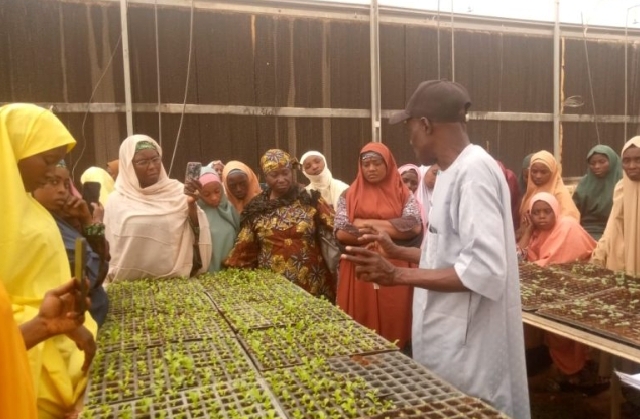
The training, which culminated in a practical field visit to the CDA Training and Research Farm, was implemented under the Resilient Opportunities for Outreach, Trade and Sustainability (ROOTS) Project. The project is implemented by AHIP in partnership with the International Organization for Migration (IOM) and supported by the European Union through the Free Movement of Persons and Migration in West Africa Phase II (FM West Africa II) Program.
The initiative was designed to equip women farmers with practical, climate-smart agricultural techniques to improve productivity, strengthen food security, and create sustainable livelihood opportunities within their communities.
Speaking during the field exercise, AHIP Program Officer Amina Raji said participants had earlier received training on home-based farming techniques that require limited space and resources before proceeding to practical demonstrations at the CDA farm.
She explained that the program seeks to empower women with modern agricultural knowledge and skills that can increase household income and promote self-reliance.
“We want these women to see agriculture not only as a means of feeding their families but also as a pathway to economic empowerment,” she said.
Raji added that AHIP is exploring opportunities to support the participants beyond the training, including efforts to establish an association that would enable them to learn from one another and access future opportunities.
Also speaking, the Manager of the CDA Training and Research Farm, Ibrahim Musa Maina, introduced participants to greenhouse farming and other modern agricultural practices suitable for smallholder farmers.
According to him, crops such as vegetables, cereals, legumes, and fruits can be successfully cultivated through home gardening and sack farming techniques, making agriculture more accessible to women with limited land and resources.
He reaffirmed the center’s commitment to supporting farmers through continuous training and knowledge sharing to encourage sustainable agricultural development.
One of the participants, Grace Musa from Bunkure, described the training as valuable and practical. She said the sessions helped her better understand fertilizer application and sack farming techniques, knowledge she believes will improve her harvest and reduce farming losses.
She also pledged to share what she learned with other women in her community.
The training forms part of AHIP’s broader efforts under the ROOTS Project to strengthen community resilience, create sustainable livelihood opportunities, and address some of the socioeconomic factors that contribute to irregular migration.
This activity was first reported by Paradigm News and has been adapted for publication on the AHIP website. Source: https://paradigmnews.ng/35973-2/